
Maruti Suzuki, India’s trusted carmaker for decades, is finally stepping into the electric vehicle (EV) arena with bold plans that promise to reshape urban driving. Long known for affordable petrol and CNG cars, Maruti’s EV entry marks a thrilling shift towards sustainable mobility, starting with the much-awaited e Vitara in early 2026. For Indian families dreaming of zero-emission rides without breaking the bank, this is a game-changer.
The buzz around Maruti Suzuki EV lineup has families from Delhi to Chennai talking. With government pushes for green transport and rising fuel costs, Maruti’s electric car launch couldn’t come at a better time. Expect practical features, long ranges, and that signature Maruti reliability to make EVs accessible for everyday Indians.
Why Maruti’s EV Entry Matters for Indian Roads
India’s roads are evolving fast, with EV sales surging amid schemes like FAME-III and state subsidies. Maruti Suzuki, holding over 40% market share in ICE cars, sees the EV market India as its next frontier. Their strategy focuses on affordability, infrastructure, and variety to beat rivals like Tata and Mahindra.
Unlike premium players, Maruti prioritizes mass-market appeal. CEO Hisashi Takeuchi emphasizes EVs “across body types and segments,” aligning with Suzuki’s global vision. This means options for city commuters, highway cruisers, and even fleet operators.
For the average Indian buyer, Maruti EV roadmap reduces “range anxiety” – a top concern. With petrol at ₹100/litre, switching to electric could save lakhs over five years, making it a smart family choice.
Spotlight on e Vitara: Maruti’s First Electric SUV
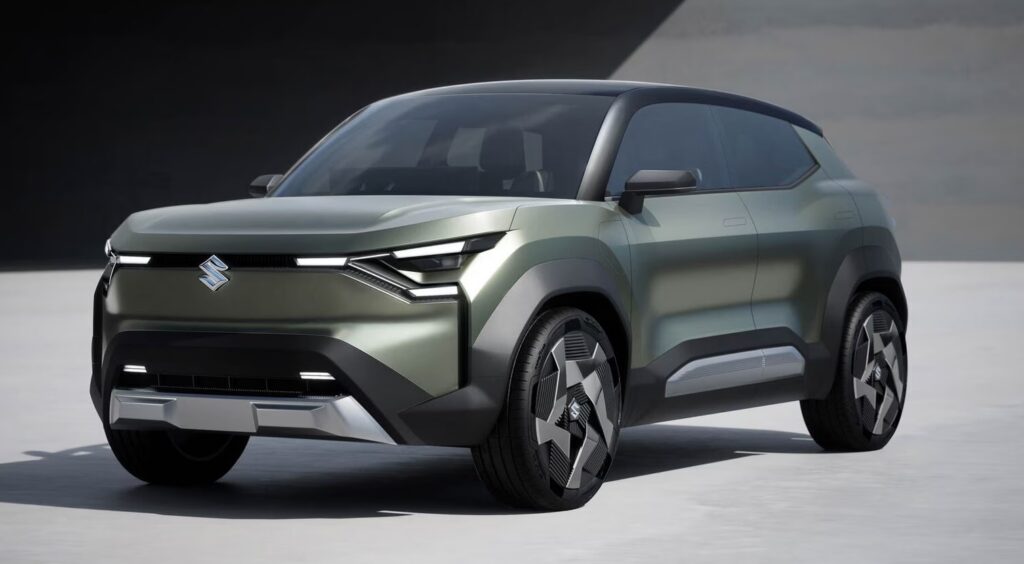
The Maruti e Vitara leads Maruti’s EV entry, unveiled recently with a 5-star Bharat NCAP rating – India’s first for an EV SUV. This midsize electric SUV blends rugged looks with modern tech, targeting the sweet spot between Brezza and Grand Vitara.
Built on the dedicated HEARTECT-e platform, it offers two battery packs: 49 kWh LFP (344-500 km range) and 61 kWh LFP (up to 543 km ARAI). Power ranges from 142 bhp (FWD) to 172 bhp with ALLGRIP-e 4WD for off-road fun.
Inside, expect a dual-screen setup with 10.1-inch infotainment, wireless Apple CarPlay/Android Auto, ventilated seats, and ADAS Level-2 features like adaptive cruise and lane-keep assist. Colors include 10 options, four dual-tone, perfect for style-conscious buyers.
Priced around ₹20-26 lakh (expected), it undercuts rivals while offering Battery-as-a-Service (BaaS) – rent the battery monthly to slash upfront costs. Plus, an assured buyback program eases resale worries.
Bookings open soon, sales from January 2026 – just in time for festive seasons ahead.
Maruti’s Ambitious EV Roadmap Beyond e Vitara
Maruti Suzuki EV plans don’t stop at one model. By 2030, expect at least four EVs, including an entry-level hatchback to rival Tata Tiago EV and MG Comet EV.
- Electric Hatchback: Affordable city runabout, under ₹10 lakh, for daily commutes.
- e-Fronx Crossover: Compact EV version of the popular Fronx, launching post-2026.
- Electric MPV (YMC): Family hauler by 2030, codenamed for multi-seater needs.
- More Hybrids: Fronx strong hybrid in 2026, followed by Baleno, Brezza, Swift.
This lineup covers hatchbacks, SUVs, MPVs – ensuring Maruti electric vehicles fit every budget and lifestyle.
Building India’s Largest EV Charging Network
No EV succeeds without chargers. Maruti invests ₹250 crore in infrastructure, targeting 1 lakh charging stations by 2030 – the largest fast-charging network.
Already, over 2,000 exclusive points span 1,100+ cities, including Delhi-Chandigarh highways (63 points alone). Partner-led expansion ensures a charger every 5-10 km.
The ‘e for me’ app simplifies it all: locate stations, pay digitally, schedule home charging, and book services. With 1,500 EV-ready workshops and 1.5 lakh trained staff, after-sales rival ICE support.
This ecosystem tackles India’s charging gaps, making Maruti EV ownership hassle-free for Tier-2/3 buyers.
Challenges and Opportunities in Maruti’s EV Push
India’s EV penetration is just 2-3%, held back by high prices and infra. Maruti counters with local production, LFP batteries (safe, durable), and subsidies leverage.
Competition heats up from Tata Nexon EV, Mahindra XEV 9e, but Maruti’s volumes and service network give an edge. Exports to Japan alongside India launch boost credibility.
For readers, it’s exciting: lower running costs (₹1-2/km vs ₹8-10 for petrol), eco-benefits, and tech upgrades. Maruti’s EV entry could electrify 15% of their sales by 2030.
(Word count: 1028)
FAQs
When is the Maruti e Vitara launching?
Sales start January 2026, with bookings soon after.
What is the range of Maruti e Vitara?
Up to 543 km (ARAI) on the 61 kWh pack.
Does Maruti offer EV charging support?
Yes, aiming for 1 lakh stations by 2030 via partners and app.
Are there affordable Maruti EVs coming?
Yes, an entry-level hatchback to rival Tiago EV by 2030.
What makes e Vitara safe?
5-star Bharat NCAP rating with ADAS Level-2.